

How to Handle the 20 Most Common Sales Objections (With Word-for-Word Responses)
The Viking Mindset for Sales Success
12
12
min read


Every sales rep knows the feeling.
You're mid-pitch. The conversation is flowing. Then your prospect hits you with "We don't have the budget right now" — and your mind goes blank.
You fumble. You discount too early. You promise to "follow up next quarter." The deal dies.
Here's the thing: the objection isn't the problem. Your response is.
Top performers don't avoid objections — they welcome them. An objection means the prospect is engaged enough to push back. That's a buying signal, not a rejection.
We analyzed hundreds of sales calls and distilled the 20 most common B2B objections into a complete playbook — with the psychology behind each one and exactly what to say.
The Framework: A.C.E.
Before we get into specific objections, you need a framework. Memorizing scripts doesn't work because every conversation is different. But a repeatable process does.
We call it A.C.E.
A - Acknowledge - Validate the concern. Don't dismiss, don't argue. Show the prospect you heard them and their concern is legitimate. This drops their guard.
C- Clarify - Ask a question that gets to the real objection underneath. The stated objection is rarely the actual blocker. Dig one level deeper to find the truth.
E - Engage - Re-engage with a reframe, proof point, or next step. Move the conversation forward. Don't just survive the objection, use it as a pivot to advance the deal.
The 5 Categories
Sales objections fall into five buckets:
• Price & Budget — "Too expensive," "No budget," "Competitor is cheaper"
• Timing & Urgency — "Not right now," "Call me next quarter"
• Authority — "I need to talk to my boss," "We have a committee"
• Trust & Risk — "We got burned before," "How do I know this works?"
• Status Quo & Inertia — "We're fine with what we have," "Too much hassle to switch"
Price & Budget: "It's too expensive."
What they really mean: They haven't connected your price to the value they'll get.
What to say: "Fair enough — let's talk about what 'expensive' means in context. What's the cost of NOT solving this? If your team keeps losing deals because they freeze on objections, what does that cost you per quarter in missed revenue?"
You don't defend the price. You shift the conversation to cost of inaction.
Price & Budget: "We don't have the budget right now."
What they really mean: Could be real budget constraints, or a polite brush-off. Your job is to figure out which.
What to say: "Totally understand — budgets are tight everywhere. Quick question: if budget wasn't a factor, is this something you'd move on? Because if yes, let's figure out the timing together."
If they say "even without budget, we're not interested" — now you know the real objection isn't budget.
Timing: "Not right now. Maybe next quarter."
What they really mean: They don't see enough urgency to act today.
What to say: "Help me understand — what changes next quarter that makes this a better time? Because what I typically see is that the problems we solve compound. Every month without a solution is another month of missed deals."
Make them articulate why later is better. Usually, they can't.
Trust: "We've been burned by vendors before."
What they really mean: Someone sold them a dream and under-delivered. They're protecting themselves.
What to say: "Appreciate you being honest about that. Can I ask what specifically went wrong? Because I'd rather address those concerns head-on than pretend they don't exist. What would we need to show you to prove this is different?"
You're not dismissing their experience. You're asking them to define what "good" looks like.
Want All 20 Objections?
These are just 4 of the 20 objections covered in our complete playbook. The full Objection Handling Playbook includes:
• All 20 objections with word-for-word responses
• The psychology behind each objection
• The APCC framework explained in detail
• Pro tips from experienced sales leaders
A dedicated section on Status Quo & Inertia (the hardest objections to crack)
Download the free playbook and get the complete PDF delivered instantly.
Why Objections Are Actually Good News
If a prospect objects, it means they're still in the conversation. The deals that die silently — the ones that ghost you — those are the real losses.
An objection is an invitation to have a deeper conversation. The reps who treat objections as opportunities consistently outperform those who treat them as roadblocks.
What If You Had These Responses in Real-Time?
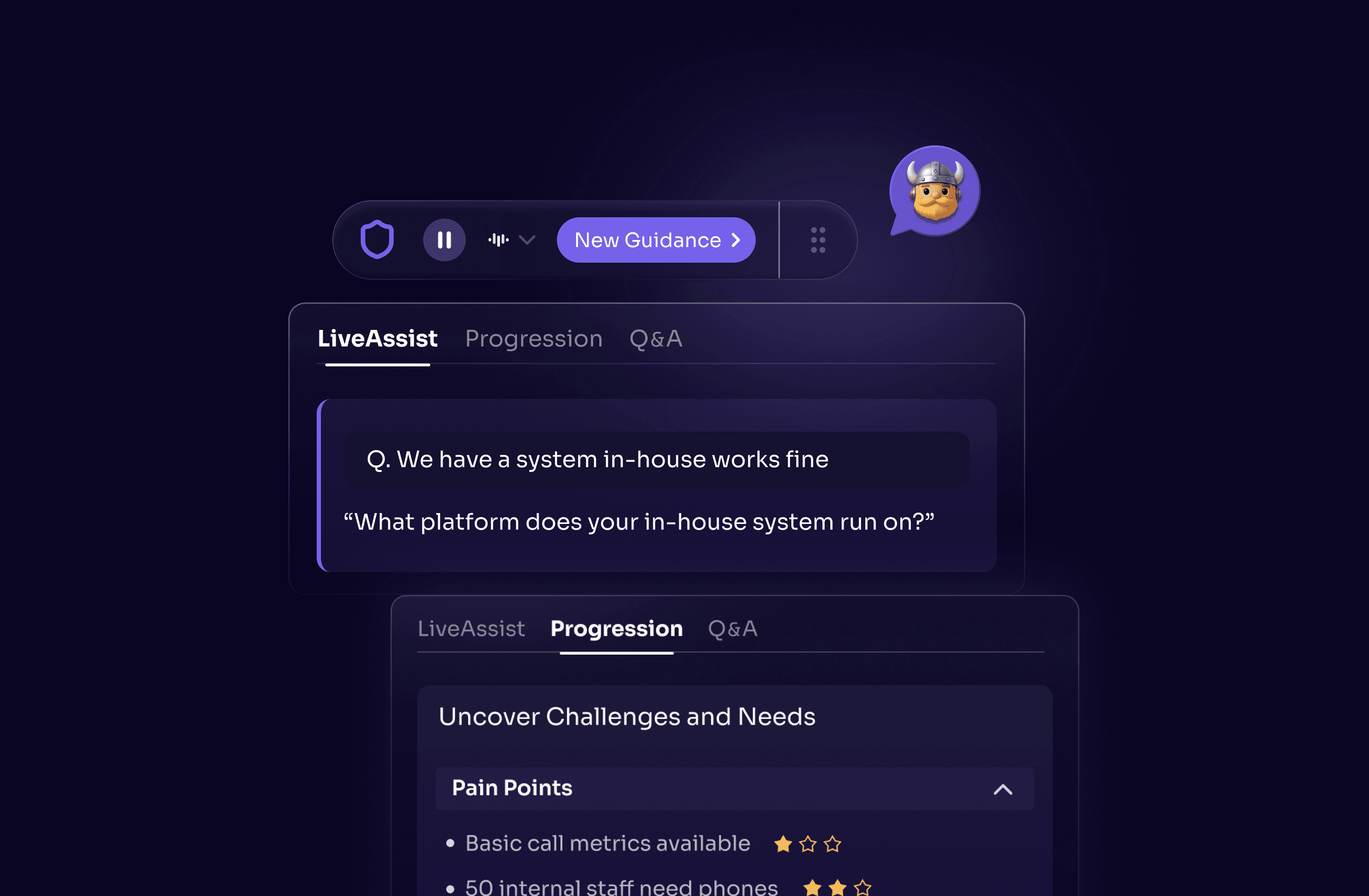
Imagine you're on a live sales call. The prospect hits you with an objection. Instead of freezing, you see the perfect response appear on your screen — tailored to what was just said.
That's what SalesViking does. It's your AI wingmate that rides shotgun on every call:
• Real-time objection handling — the right response as the prospect objects
• Discovery question suggestions — never run out of things to ask
• Post-call analysis — see exactly where you won and lost
The playbook gives you the words. SalesViking gives you the words in the moment.
Try SalesViking free at salesviking.io — no credit card required.
Every sales rep knows the feeling.
You're mid-pitch. The conversation is flowing. Then your prospect hits you with "We don't have the budget right now" — and your mind goes blank.
You fumble. You discount too early. You promise to "follow up next quarter." The deal dies.
Here's the thing: the objection isn't the problem. Your response is.
Top performers don't avoid objections — they welcome them. An objection means the prospect is engaged enough to push back. That's a buying signal, not a rejection.
We analyzed hundreds of sales calls and distilled the 20 most common B2B objections into a complete playbook — with the psychology behind each one and exactly what to say.
The Framework: A.C.E.
Before we get into specific objections, you need a framework. Memorizing scripts doesn't work because every conversation is different. But a repeatable process does.
We call it A.C.E.
A - Acknowledge - Validate the concern. Don't dismiss, don't argue. Show the prospect you heard them and their concern is legitimate. This drops their guard.
C- Clarify - Ask a question that gets to the real objection underneath. The stated objection is rarely the actual blocker. Dig one level deeper to find the truth.
E - Engage - Re-engage with a reframe, proof point, or next step. Move the conversation forward. Don't just survive the objection, use it as a pivot to advance the deal.
The 5 Categories
Sales objections fall into five buckets:
• Price & Budget — "Too expensive," "No budget," "Competitor is cheaper"
• Timing & Urgency — "Not right now," "Call me next quarter"
• Authority — "I need to talk to my boss," "We have a committee"
• Trust & Risk — "We got burned before," "How do I know this works?"
• Status Quo & Inertia — "We're fine with what we have," "Too much hassle to switch"
Price & Budget: "It's too expensive."
What they really mean: They haven't connected your price to the value they'll get.
What to say: "Fair enough — let's talk about what 'expensive' means in context. What's the cost of NOT solving this? If your team keeps losing deals because they freeze on objections, what does that cost you per quarter in missed revenue?"
You don't defend the price. You shift the conversation to cost of inaction.
Price & Budget: "We don't have the budget right now."
What they really mean: Could be real budget constraints, or a polite brush-off. Your job is to figure out which.
What to say: "Totally understand — budgets are tight everywhere. Quick question: if budget wasn't a factor, is this something you'd move on? Because if yes, let's figure out the timing together."
If they say "even without budget, we're not interested" — now you know the real objection isn't budget.
Timing: "Not right now. Maybe next quarter."
What they really mean: They don't see enough urgency to act today.
What to say: "Help me understand — what changes next quarter that makes this a better time? Because what I typically see is that the problems we solve compound. Every month without a solution is another month of missed deals."
Make them articulate why later is better. Usually, they can't.
Trust: "We've been burned by vendors before."
What they really mean: Someone sold them a dream and under-delivered. They're protecting themselves.
What to say: "Appreciate you being honest about that. Can I ask what specifically went wrong? Because I'd rather address those concerns head-on than pretend they don't exist. What would we need to show you to prove this is different?"
You're not dismissing their experience. You're asking them to define what "good" looks like.
Want All 20 Objections?
These are just 4 of the 20 objections covered in our complete playbook. The full Objection Handling Playbook includes:
• All 20 objections with word-for-word responses
• The psychology behind each objection
• The APCC framework explained in detail
• Pro tips from experienced sales leaders
A dedicated section on Status Quo & Inertia (the hardest objections to crack)
Download the free playbook and get the complete PDF delivered instantly.
Why Objections Are Actually Good News
If a prospect objects, it means they're still in the conversation. The deals that die silently — the ones that ghost you — those are the real losses.
An objection is an invitation to have a deeper conversation. The reps who treat objections as opportunities consistently outperform those who treat them as roadblocks.
What If You Had These Responses in Real-Time?
Imagine you're on a live sales call. The prospect hits you with an objection. Instead of freezing, you see the perfect response appear on your screen — tailored to what was just said.
That's what SalesViking does. It's your AI wingmate that rides shotgun on every call:
• Real-time objection handling — the right response as the prospect objects
• Discovery question suggestions — never run out of things to ask
• Post-call analysis — see exactly where you won and lost
The playbook gives you the words. SalesViking gives you the words in the moment.
Try SalesViking free at salesviking.io — no credit card required.
Win more deals. Stack more commission.
SalesViking cuts the crap so you can conquer quota.

Win more deals. Stack more commission.
SalesViking cuts the crap so you can conquer quota.

Win more deals. Stack more commission.
SalesViking cuts the crap so you can conquer quota.

Win more deals. Stack more commission.
SalesViking cuts the crap so you can conquer quota.
